Which Season Is Your Soul Actually Made Of?
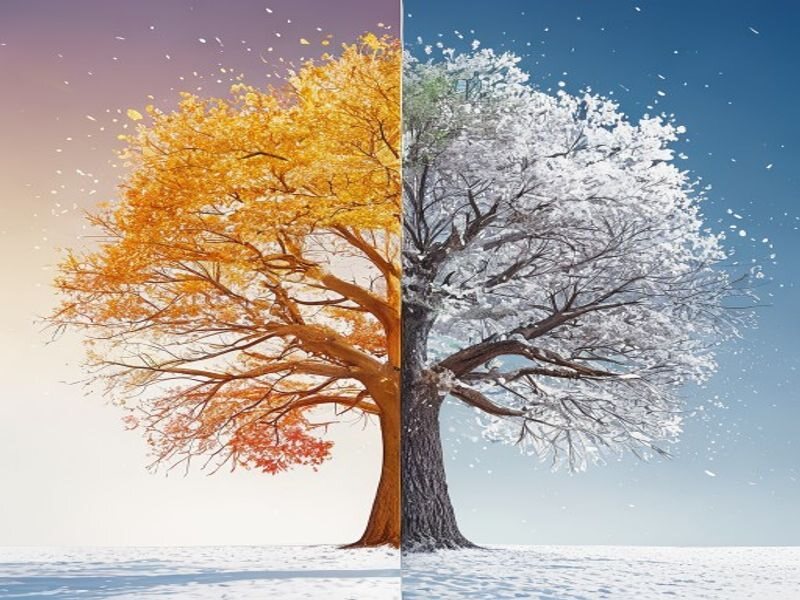
Somewhere under your everyday mood, one season quietly runs the whole operation. It shapes how you love, how you rest, what makes you feel most like yourself — no matter what the weather app insists is happening outside.
Answer seven fast questions and we'll reveal the season your soul is actually made of. Maybe it matches your favorite time of year, maybe it'll surprise you completely. Either way, stop overthinking and pick whatever feels warm, or cozy, or a little bit magic.
Read every possible outcome for this quiz and what each one means →
Seasons are a tilt, not a distance
The most common misconception about seasons is that summer happens when the Earth is closer to the Sun. It does not. The Earth reaches its nearest point to the Sun in early January, in the middle of the northern hemisphere winter, and the difference in distance across the year is far too small to matter much anyway. Seasons come from the axial tilt of roughly 23.4 degrees, which means each hemisphere in turn leans towards the Sun and receives its light at a steeper angle and for more hours a day.
There is also no single agreed date for when one begins. Astronomical seasons are pinned to the solstices and equinoxes, which wander by a day or two. Meteorologists ignore all that and use whole calendar months, because grouping December, January and February makes climate records far easier to compare. Both are correct. They are simply answering different questions.
Four is a local convention
Dividing the year into four is a habit of temperate latitudes, not a fact about the planet. Much of the tropics runs on wet and dry, and rice calendars are built around that rhythm. The traditional Japanese calendar splits the year into twenty-four solar terms and then subdivides those into seventy-two micro seasons of roughly five days, with names like the one for the period when the east wind melts the ice. The Sámi of northern Scandinavia have traditionally worked with eight, structured around the reindeer herding year rather than around a farmer's harvest.
Look at those systems for a while and the four you grew up with start to feel like one reasonable answer among several.
Light really does move people around
The seasonal effect on mood is not folklore, though it is more contested than the popular version suggests. Norman Rosenthal and colleagues described seasonal affective disorder in 1984, and bright light therapy, typically a 10,000 lux box used in the morning, has a reasonable evidence base for people with a clear winter pattern. Day length shifts the timing of melatonin release, which is the plausible mechanism.
The complication is that several large population surveys have failed to find any seasonal pattern in depression across the general public, which suggests a genuine winter subtype rather than a universal slump. So enjoy the season this quiz assigns you, and remember that twilight, charming as it sounds, is not a season at all.